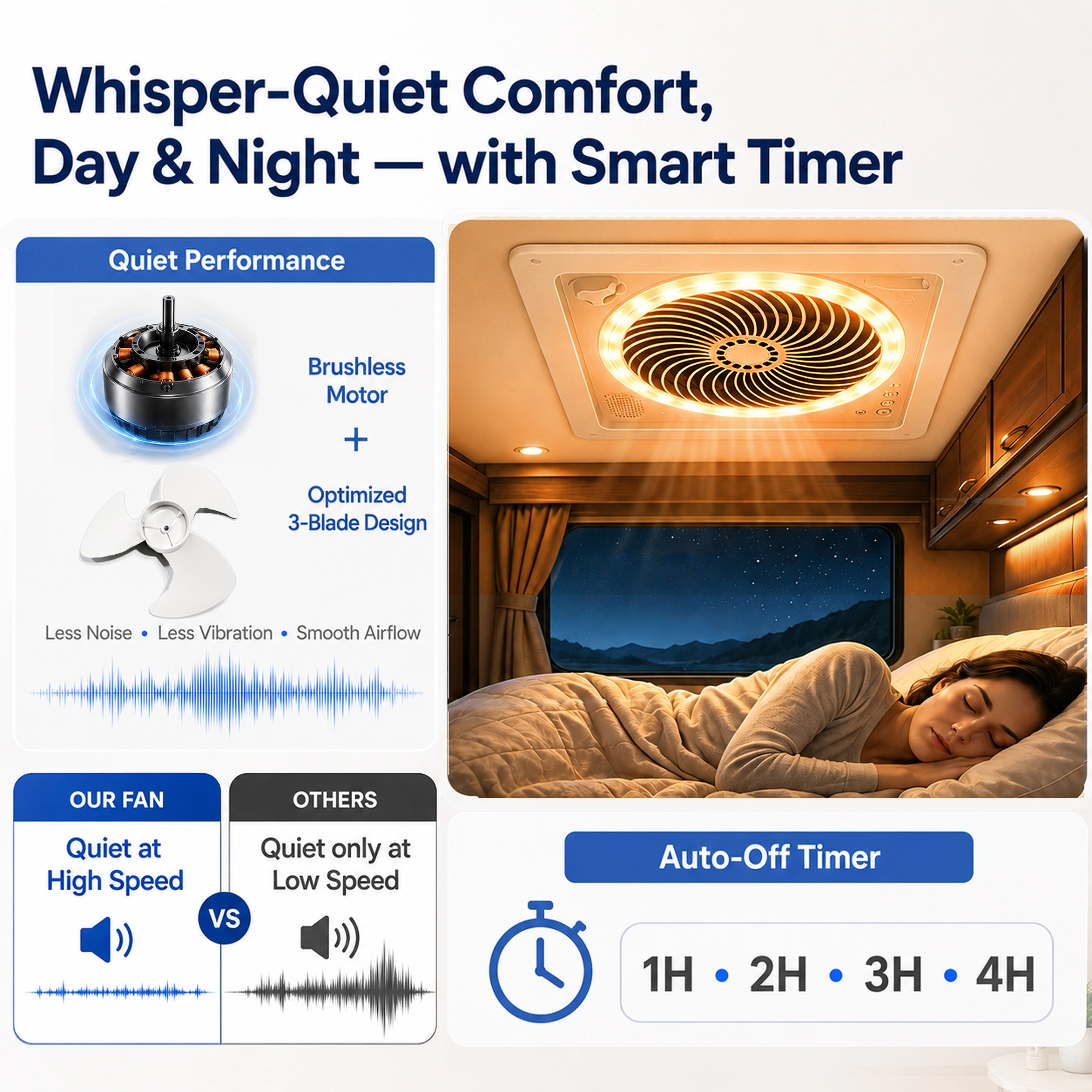
Let's be honest about something every RVer knows but rarely talks about: noise is the silent thief of camping enjoyment.
You've been there. You're lying in bed after a long day of driving, the windows cracked for fresh air, and somewhere in the darkness, a fan whirs. Not loudly—just enough. Just enough to remind you that you're not truly in nature. Just enough to make that peaceful night's sleep feel just slightly out of reach.
For years, RVers have accepted this as the price of ventilation. You want airflow? You get noise. You want to clear cooking odors? You get a humming motor. You want to stay cool in the summer heat? You get a fan that sounds like a small aircraft preparing for takeoff.
But what if that compromise no longer existed? What if you could have powerful, effective ventilation that operates at near-zero noise?
The Problem with Traditional RV Exhaust Fans
Traditional RV exhaust fans rely on brushed DC motors—the same technology that's been around for decades. These motors use carbon brushes that physically contact the commutator to transfer electricity. The friction from this contact creates several problems:
Noise. The brushes scraping against the commutator produce a mechanical whine that's impossible to eliminate. Even "quiet" fans often operate at 40dB or higher—and in the confined space of an RV, that 40dB hum can feel like a mosquito buzzing right next to your ear while you're trying to sleep.
Inefficiency. Brushed motors waste energy as heat, drawing more current than necessary and draining your battery bank faster.
Short lifespan. The brushes wear down over time, requiring replacement or leading to motor failure.
Vibration. The physical contact creates vibration that travels through the motor housing, the fan blades, and ultimately into the RV structure itself.
For off-grid campers and boondockers, these issues are amplified. Every amp counts when you're running on solar or battery power. And every decibel matters when you're trying to sleep under the stars.
The Solution: Three Technologies Working in Harmony
The answer to near-zero noise operation isn't a single innovation—it's the combination of three carefully engineered technologies working together. Here's how each one contributes to the silent revolution in RV ventilation.
1. The Brushless DC Motor: Eliminating Noise at the Source
The foundation of silent operation is the brushless DC motor (BLDC) . Unlike traditional brushed motors, BLDC motors have no physical brushes making contact with the commutator. Instead, they use electronic commutation—a controller that switches the current to the motor windings at precisely the right time.
The result?
No friction noise. Without brushes scraping against metal, the mechanical whine disappears entirely.
Smoother operation. Electronic commutation provides precise control over motor speed, eliminating the jerky, uneven motion that creates vibration and noise.
Higher efficiency. BLDC motors waste less energy as heat, drawing minimal current while delivering powerful airflow. Some advanced models operate at under 1 amp at low speeds.
Longer lifespan. With no brushes to wear out, these motors are maintenance-free and last significantly longer than their brushed counterparts.
The difference is dramatic. While traditional fans might operate at 40-60dB, high-quality brushless fans can achieve noise levels as low as 25dB or even 29dB at moderate speeds. To put that in perspective: 25dB is quieter than a whisper. It's the sound level of a quiet library. It's the kind of silence that lets you hear the crickets outside instead of the machinery inside.
"Look for fans with brushless DC motors. They aren't just energy sippers; they are whisper-quiet because they eliminate the friction of carbon brushes found in older models."
2. The Three-Blade Deep Design: Engineering Airflow, Not Noise
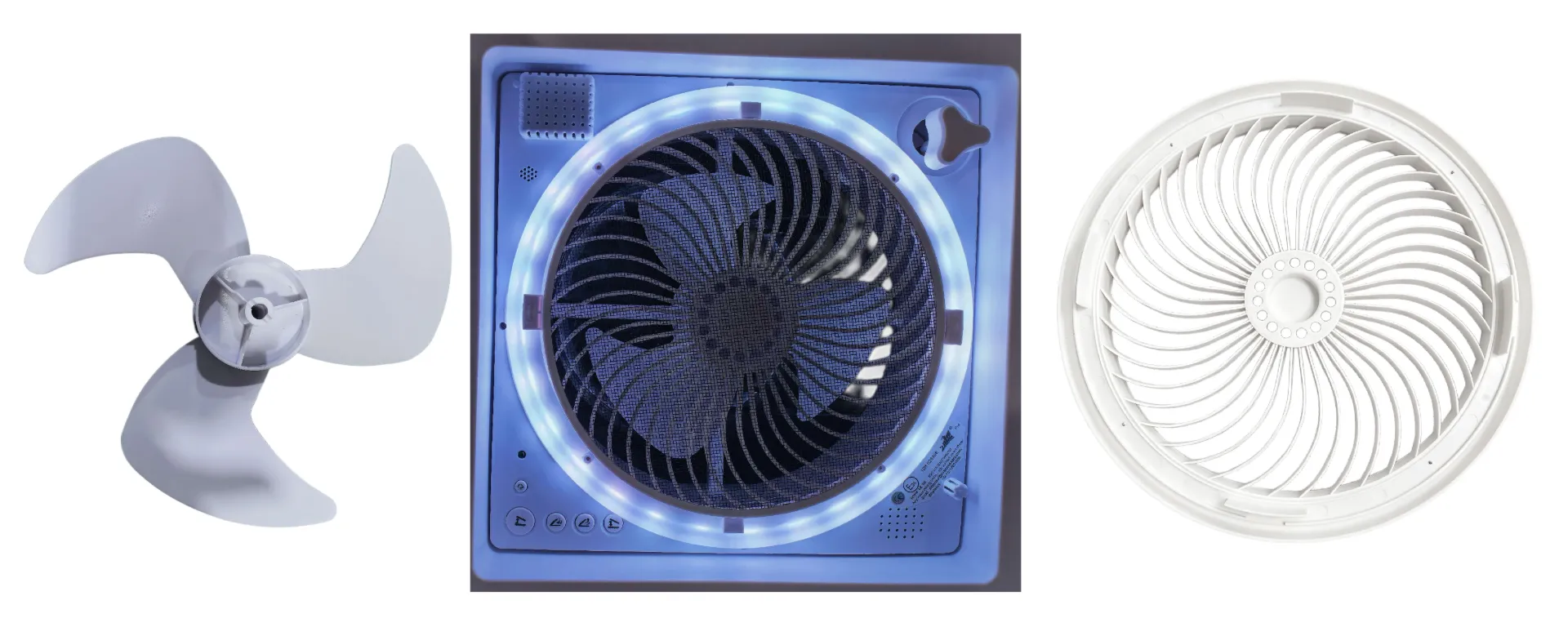
The motor is only half the story. Even the quietest motor can produce significant noise if the fan blades aren't designed properly. This is where thethree-blade deep designcomes into play.
Why Three Blades?
More blades don't necessarily mean better performance—in fact, they often meanmore noise. Each blade creates turbulence as it cuts through the air. With more blades, you get more turbulence, more wake interference, and more noise.
The three-blade configuration strikes an optimal balance:
Fewer blades mean less turbulence—each blade has more space to move air without interfering with the others
Better balance—three blades provide natural rotational balance, reducing wobble and vibration
More efficient airflow—each blade can be optimized for maximum air movement without compromise
The "Deep" Design Difference
But it's not just about the number of blades—it's about theirshape and depth.
Deep-pitched bladesare engineered to move high volumes of air while operating at lower speeds. This is a crucial insight for noise reduction:lower RPM means less noise. By using deeper, more aggressively pitched blades, the fan can move the same amount of air at lower rotational speeds, dramatically reducing both aerodynamic noise and motor noise.
The deep design also incorporatespatented curved surfaces and precise dynamic balance. These aren't just marketing terms—they represent real engineering that:wind noise by conforming to natural airflow principles
Reduces wind noise by conforming to natural airflow principles
Minimizes turbulence at the blade trailing edges
Creates smoother, more laminar airflow instead of chaotic, noisy turbulence
Some advanced designs achieve this throughpatented curved surfacesthat guide air more efficiently, reducing the chaotic wake that typically follows each blade. The result is airflow that feels natural and quiet—moving air without announcing its presence.
"With the patented curved surface and precise dynamic balance design, conforming to the principle of natural wind rotation, when the fan blade working, it reduces wind noise as much as possible."
3. The Specialized Outlet Grid with Integrated Insect Screen: Silent Protection
The third piece of the puzzle is often overlooked, but it's just as important: the outlet grid and insect screen.
The Problem with Traditional Screens
Most RV exhaust fans include some kind of insect screen. But standard screens create significant airflow resistance. As air is forced through a tight mesh, it creates turbulence, which creates noise. The screen essentially acts like a whistle—not a loud one, but a persistent, high-frequency hiss that adds to the overall noise profile.
Traditional screens also tend to clog with dust and debris, further restricting airflow and increasing noise over time.
The Solution: Purpose-Engineered Grid + Screen Integration
The specialized outlet grid is designed with two simultaneous goals: keep bugs out and keep noise down.
Optimized mesh geometry. The screen uses a grid pattern that balances two competing needs: gaps large enough for optimal airflow but small enough to keep bugs out. This isn't a one-size-fits-all mesh—it's carefully engineered to minimize airflow resistance while providing maximum protection.
Integrated design. Rather than being an afterthought, the screen is integrated into the overall aerodynamic design of the outlet grid. The grid itself is shaped to guide airflow smoothly, reducing the turbulence that creates noise.
Stainless steel construction. High-quality screens use stainless steel mesh that resists corrosion and maintains its shape over time. This means consistent airflow and consistent low noise, even after years of use.
Easy maintenance. Removable screens allow for quick cleaning—because a clean screen is a quiet screen.
The result is protection without compromise. You get bug-free ventilation that operates at near-zero noise, without the hiss and whistle of traditional screens.
"With built-in fine screen or bug screen: Fine screens reduce insect intrusion while keeping air flowing."
The Combined Effect: Near-Zero Noise Ventilation
When these three technologies work together, the result is transformative:
| Component | Contribution to Silence |
|---|---|
| Brushless DC Motor | Eliminates mechanical friction noise; smooth, vibration-free operation |
| Three-Blade Deep Design | Maximizes airflow at lower RPM; reduces aerodynamic turbulence |
| Specialized Grid + Screen | Minimizes airflow resistance; eliminates screen whistle |
Together, they create a ventilation system that:
Operates at whisper-quiet levels. Some advanced systems achieve ≤29dB at moderate speeds—quiet enough for peaceful sleep, quiet enough to hear nature outside your window.
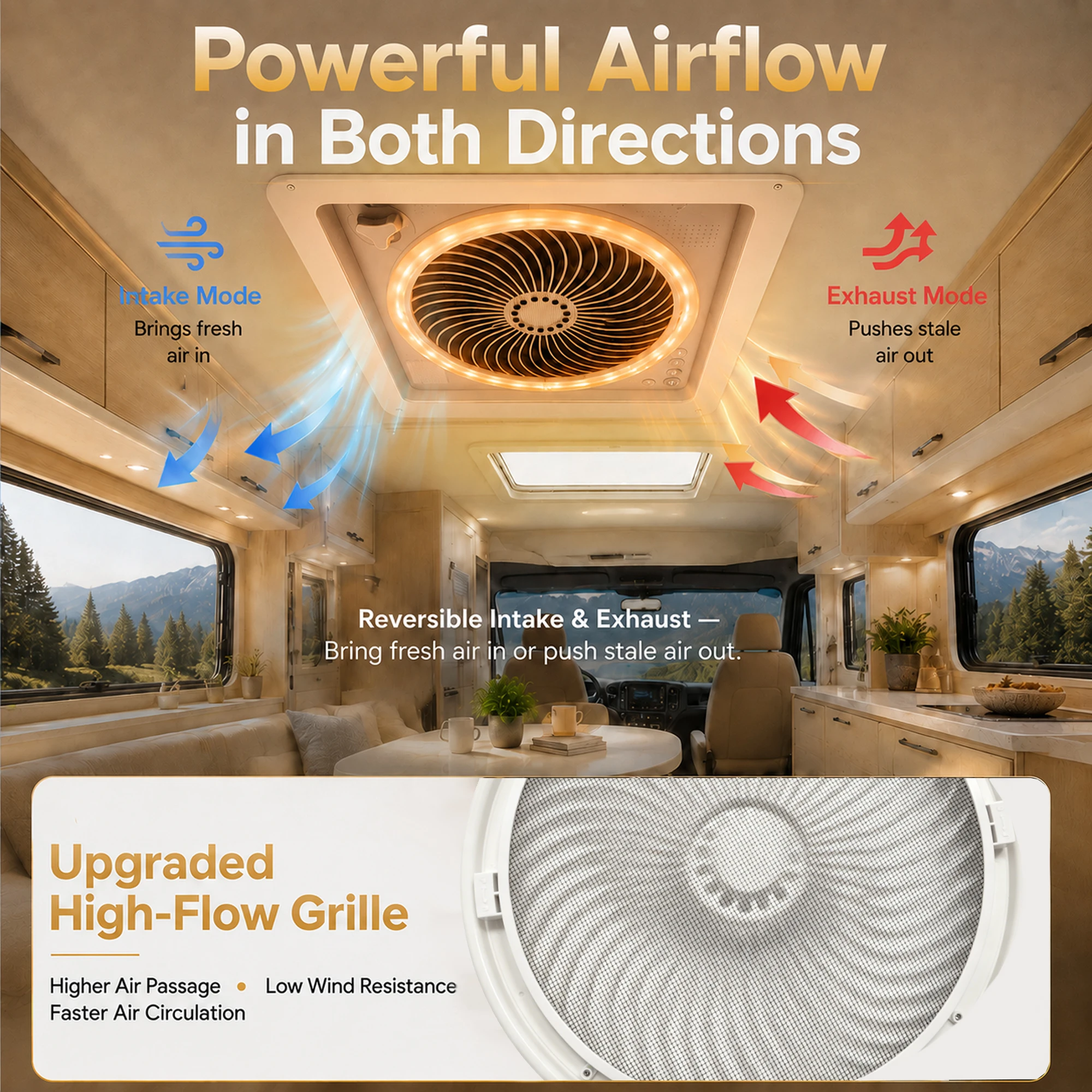
Delivers powerful airflow. Despite the silence, these fans move serious air—enough to exchange the air in your RV multiple times over.
Runs all night. With low power draw and quiet operation, you can leave the fan running while you sleep, maintaining fresh air without disturbing your rest.
Protects without compromise. The integrated insect screen keeps bugs out without creating the hiss and whistle of traditional screens.
What This Means for Your RV Experience
The pursuit of near-zero noise isn't about a single decibel number. It's about reclaiming what camping should be.
It's about lying in bed at night and hearing the wind in the trees—not the whir of a fan motor.
It's about having a conversation in your RV without raising your voice over background noise.
It's about waking up refreshed because you weren't subconsciously fighting against mechanical noise all night.
It's about respecting your neighbors in crowded campgrounds—because your fan isn't the one keeping everyone awake.
And it's about boondocking with confidence—knowing that your ventilation system sips power instead of gulping it, extending your off-grid adventures.
"Quiet operation matters for restful nights and conversations inside the RV."
The Bottom Line
For decades, RVers have accepted noise as the price of ventilation. But that compromise is no longer necessary.
The combination of brushless DC motors, three-blade deep designs, and specialized outlet grids with integrated insect screens represents a fundamental shift in what's possible. These aren't incremental improvements—they're a complete rethinking of how an exhaust fan should work.
The result is ventilation that's powerful, efficient, and practically silent—ventilation that lets you enjoy the sounds of nature instead of the sounds of machinery.
Because in the end, the best technology is the technology you don't notice. And the quietest fan is the one you forget is even running.
Have you experienced the difference a truly quiet exhaust fan makes? Or are you still putting up with the hum, the whine, and the vibration of an older fan? The silence is waiting—and it's worth every decibel saved.